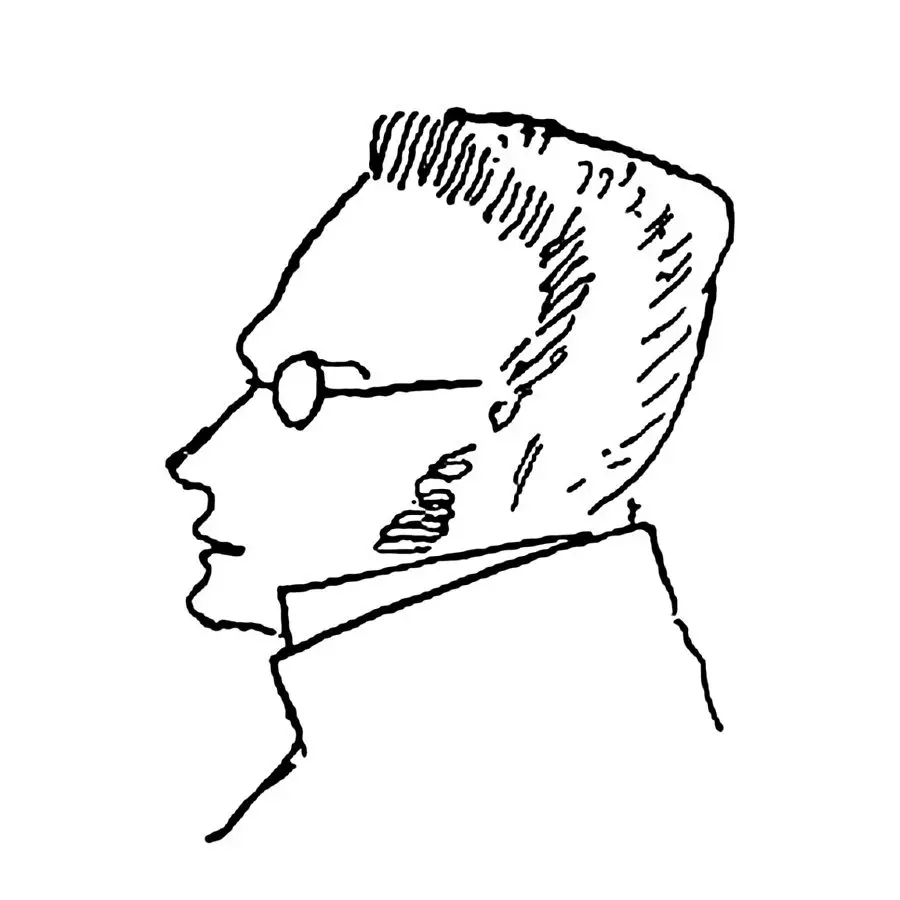
The inner voice

Goran Schill asked:

Hi, I wonder if the constant inner monologue I have in my self-conscious mind suggests that there is only one part of myself. When I ask myself if I should grab a beer in the fridge, and I hear one voice saying “yes, nice, you deserve it” and another “no, go to the gym and work on your belly instead”, and then there is a will inside me that decides to either close the fridge and go to gym, or open the beer, are these voices and this will just one single unit of myself, or are there two or even three parts of my self-conscious self? One reason I am asking is that I wonder if Plato’s tripartite soul may be at work here: the appetitive (have a beer), the rational (go to gym) and the spirited (will to decide either). Or is this just amateurish hairsplitting?

Answer by Graham Hackett

I often think that, in talking about consciousness, the only serious game in town is the argument between those who believe that human consciousness is a part of us which is separate from our material selves, and those who think we are just body. As human beings, some would say that we are not just our body, physical makeup, phenotype, etc. We also have a soul, a mind, a consciousness; however you wish to designate it. The consciousness is really us, much more so than our physical constitution. 

If you believe that we have a consciousness separate from our physical make-up, then you might get into a secondary discussion about how this works out in practice. Plato liked to think of a “soul” which had the parts you describe, which performed performed various functions such as providing direction (reason), sufficient vigour and vim (spirit) to proceed in this direction, and finally, appetite, (to make sure we are properly sustained our nourished). Freud, regarding himself as rather more scientific than Plato, parcelled us up into id, ego and super-ego. In your own case, you were wondering whether there were different voices, etc, which might decide you either have a beer, go to the gym, or ruminate a bit more about it.

How likely is this? It occurs to me from time to time, that we are making a lot of this up as we go along. We are so strongly sure of the sense of our own selves (think of Descartes “cogito”), that we may be giving ourselves special privileges when we compare ourselves with brute beasts, whom, we surmise, may not have this powerful feeling. I do not wish to be disrespectful to Plato, who has spent a great deal of his powerful intellect building a philosophical position to be admired. However, is there any reason to believe in attempts to divide our consciousness into supposedly functional parts, especially when we might want to query the very concept of consciousness itself?

When I read your amusing description of your soliloquy with your fridge, I was reminded of a famous observation by Hume.

“There are some philosophers, who imagine we are every moment conscious of what we call our SELF; that we feel its existence and continuance in existence; and are certain, beyond the evidence of a demonstration, both of its perfect identity and simplicity. …[But] from what impression could this idea be deriv’d? …For my part, when I enter most intimately into what I call myself, I always stumble on some particular perception or other, of heat or cold, light or shade, love or hatred, pain or pleasure. I never can catch myself at any time without a perception, and never can observe anything but the perception.

“…I may venture to affirm …that [persons] are nothing but a bundle or collection of different perceptions, which succeed each other with an inconceivable rapidity, and are in perpetual flux and movement.”

How can you go from your “particular perceptions” of fridge, bottle of beer, pleasure at the contemplation of the beer and guilt at the thoughts about the gym to a feeling that parts of your self are regimenting your responses?

My own particular view of consciousness is strongly influenced by scientific discoveries in neurology and brain function. I think that consciousness is a self-organised emergent property of property of billions of neurons firing in patterns in the brain. This leaves open the question as to whether self-consciousness really exists. Isn’t a property — even a self-organised emergent one — a real thing? It is certainly real enough to help me organise myself about whether I eventually take the beer or go to the gym. Or prevaricate.

What is a ‘thing’?

Himangsu asked:

What is a “thing”? Can we call a conscious being a “thing”?

Answer by Jürgen Lawrenz

The answer to the first question is, that this is one of those ‘household’ words that fits many contexts and situations. According to the Oxford Dictionary, “thing” has 18 different meanings, many of which have nothing to do with each other. So for a start, you should look this up yourself and be surprised by how many different uses a single English word can have in common parlance.

All the same, there is ‘chief meaning’ on top, which is that of an object belonging to the class of inanimate artefacts, i.e. all the physical objects naturally formed in the world as well as commodities, devices, implements, machines and so on made by humans.

Note now that the stress lies on ‘inanimate’. Organisms aren’t normally called ‘things’, least of all conscious organisms. At most, one might use the word as an insult. This goes so far as denying the legitimate use of ‘thing’ for the dead; instead we say ‘corpse’ for a deceased body, whether human or animal.

One puzzling issue that perhaps you had at the back of your mind, is the dream of humans “playing God” and creating a thing-like entity at some time in the future that exhibits an intentionality which resembles our own so much that we cannot distinguish it from conscious intentionality. If this were ever to happen, it would certainly affect our language use as well, because it would open a cleft on the line we presently draw between animate and inanimate. But for the moment these deliberations must be reserved to the Scifi industry (which has not, as far as I know, come to grips yet with the predicament it would pose to the way we speak about ‘things’!).

Would the world exist if I did not?

Cassandra asked:

When I was a child, I started asking myself: Why am I me? Why do I exist instead of not existing?

Now as an adult, this question started bothering me again as I started trying for a baby. With each cycle, I wondered, what if I conceive a baby today and not tomorrow? If a baby was to be conceived in any case, they would be a different person depending on if we have sex today or tomorrow.

What if my own parents had had sex on another day? They might have had another child that wouldn’t have been me, hence I would have never existed. Of course then I would not have been there to ask the question. But why am I there to ask? What if I didn’t exist at all? It’s like I’m feeling my own consciousness looking at itself in the mirror for the first time and realizing it exists!

Then it brings me to the idea that if I didn’t exist (or when I’ll cease to exist when I die), my entire perception of the world will cease to exist too. Then it will be as if the world didn’t exist at all, at least from my own point of view (which will be no more!). The/ my entire world will just cease to exist. The real world might as well cease to exist too. This really makes my brain hurt.

It just really freaks me out that I exist instead of not existing. I can’t imagine stopping to exist. This fills me with incredible anxiety.

My question actually is: Are there any philosophers who wrote about this? I would very much like to read them and find a bit of comfort in knowing I am not alone with my existential anxiety. I would also like to know more about this kind of double-sided perception of the world, for instance the idea that popped into my head that if I stop existing then the world will stop too (because I won’t be there to be conscious of it). I know it’s not how reality works but now that I’ve seen it from this point of view I cannot un-see it.

Answer by Geoffrey Klempner

Cassandra, I know exactly what you mean. Just so that you can be reassured that you are not alone in your existential anxiety, here is a comment that was posted three weeks ago on my very first YouTube video from 2013 Why am I here?:

Why am I here?… How am I here? I have been asking myself these questions every single day since I was a child. I think about it very deeply. “Why me?” “Why not a world without me?” “How and why am I in and of this existence.” I just can’t get my head around it. But I feel very lucky to be here and I’m glad I’m here. I just don’t know how or why! The only thing I think I know is that we must be conscious and self aware on another level. Most people I know have never asked these questions to themselves. Makes me think everyone is an unconscious robot, running on DNA programming and there is only a few truly conscious beings in this world.

The author, ‘Gaming Junkie’, has a YouTube channel for video gaming — which just goes to show that you can never predict the kind of person who will be grasped by your question, which is also very much my question.

But why are you so sure that, ‘if my own parents had had sex on another day… they might have had another child that wouldn’t have been me, hence I would have never existed’? How do you know that? As I have stated more than once on these pages, I might not have existed but someone exactly like me might have existed in my place. Meaning: it isn’t even necessary to suppose that your parents might have had sex on a different day. Everything could have been the same, down to the very last subatomic particle, and you might not be here now, the entire universe remaining exactly as it is, unchanged.

What do I mean? I would still be here, answering Cassandra’s question. Cassandra would still have asked her question. But you would not be Cassandra, because you would not be, period.

Then what about the world? How can I be so sure that the world would still exist if I had not existed?

As I once argued (in my book Naive Metaphysics: A theory of subjective and objective worlds, 1994) the view that the world would not exist if I did not, or ‘solipsism’ to give its popular name, runs into serious difficulties with the concept of truth. I become the sole arbiter of what is true or false and my judgement always goes. If I change my mind about any topic I was right to change my mind, and if I change my mind again I was right to change my mind again. Without a world there is no external standard, nothing to relate my judgements to except my other judgements. The world becomes my private dream.

As an illustration of this point, imagine a variant of the game of archery, where each arrow has a little target attached to the arrow head. Then you can never fail to hit ‘the target’. Wherever the arrow lands, you score a bull’s-eye every time!

So what? What does that prove? Absolutely nothing. One of the fundamental errors made by academic philosophers is believing that logic, or ‘discursive reason’ can establish firm conclusions on the ultimate questions of philosophy. It would be perfectly possible to argue, on the basis of the theory of materialism — which is not a new theory but has been around for 2,500 years — that my statement, ‘I might not have existed but someone exactly like me might have existed in my place’ is exactly what a material being would say and believe, on the basis of a ‘necessary illusion’ generated by the nature of consciousness. The only problem is that the theory of materialism is itself unproved and unprovable. And also, in my opinion, absurd.

In my latest YouTube video, Descartes and the soul I go so far as to describe materialists as ‘cretins’ and I stand by that judgement. Maybe, as Gaming Junkie suggests, they are in fact zombies. I could believe that. But a knock-down, conclusive proof I have not. If you look at the literature on philosophy in the analytic tradition you will find reams of articles on various thought experiments that philosophers have explored such as Frank Jackson’s ‘Mary the super-scientist’ or John Searle’s ‘Chinese Room’, with utterly inconclusive results. Believe what you want to believe.

We don’t know what consciousness is. We think we do. We think we have the human mind more or less taped. As I argue in my video, knowing the functions of the mental isn’t knowing what it is any more than knowing that a car can turn right or left, or go 100 miles in one hour, or has lights that you can switch on in the dark, tells you what a car is.

Something that looks, talks and walks like a duck can still be a fake duck. When so much is uncertain, we have to hold fast to what we know to be undeniable. I know that I exist, or, at least, that I exist now, at this very moment. And you know the same about you. What follows from that, no-one can know for sure.

The formula of soul

Suman asked:

In our nature each and every thing has a formula.In our artificial world each and every thing has an relationship with nature it may be a energy. Means water has a formula H20 by which formula we can prepared water. For ‘FAN’ we need iron copper and some energy to run it. So do you have some idea about what is the energy to make a soul or a life ? What is the energy required for a soul?

Ex-electricity — moving of electrons called electricity or electric energy.

So what is the formula of a soul?

In my conclusion I want to say that my thought is if we can get the formula of a soul or life then we can alive a dead body and human will never die.

Answer by Jürgen Lawrenz

With your conclusion you are jumping much too fast, while the issue preceding it has not even been discussed! So — slow down and let’s look at a few things together which are all “forms of energy” and can be expressed in a formula.

Let’s agree therefore that all things are made of atoms. As it doesn’t matter much whether they are gaseous, liquid or solid, we will ask: What is their formula? Answer: An abridged account of their atomic constitution in a molecule. So water results from 2 hydrogen and 1 oxygen atom sticking together, written as H2O. Likewise SiO4, which is a molecule of 1 silicon and 4 oxygen atoms and denotes quartz. These abbreviations are common practice and can be looked up in any dictionary of chemical symbols.

But the dictionary would also inform you about the energy (inert, volatile etc.) of the molecule. How do we know all this? We have instruments to measure them — plain and simple. All things that exist can be measured this way.

But now look at yourself in the mirror and ask, “where and what is my soul?”

You think it’s energy? But this does not sit well with the idea of all existing things being made of atoms! Souls are not atomic, otherwise we could weigh or measure something and identify the species of energy.

You will realise now that this is exactly the problem of religion with science. None of our instruments respond to the motions of the soul. They remain invisible, inaudible, untouchable — as if nothing is there.

Just be sure not to confuse the motions of the brain with the motions of the soul. In fact, this is a good example for the difference. Whatever the brain generates in terms of energy can be made visible on oscilloscopes, even if we don’t know what kinds of thoughts the person has. But no energy has ever been discerned that we could associate with a soul.

So here you have the answer to why there is no formula for a soul. As it eludes our most powerful measuring devices, we have only two choices. Either that it is immaterial or else that there is no such thing as a soul. But this is ultimately your choice, as no-one, scientist or philosopher, can genuinely help you to come to a decision on this dilemma.

Why am I me?

Cassandra asked:

When I was a child, I started asking myself: Why am I me? Why do I exist instead of not existing?

Now as an adult, this question started bothering me again as I started trying for a baby. With each cycle, I wondered, what if I conceive a baby today and not tomorrow? If a baby was to be conceived in any case, they would be a different person depending on if we have sex today or tomorrow.

What if my own parents had had sex on another day? They might have had another child that wouldn’t have been me, hence I would have never existed. Of course then I would not have been there to ask the question. But why am I there to ask? What if I didn’t exist at all? It’s like I’m feeling my own consciousness looking at itself in the mirror for the first time and realizing it exists!

Then it brings me to the idea that if I didn’t exist (or when I’ll cease to exist when I die), my entire perception of the world will cease to exist too. Then it will be as if the world didn’t exist at all, at least from my own point of view (which will be no more!). The/ my entire world will just cease to exist. The real world might as well cease to exist too. This really makes my brain hurt.

It just really freaks me out that I exist instead of not existing. I can’t imagine stopping to exist. This fills me with incredible anxiety.

My question actually is: Are there any philosophers who wrote about this? I would very much like to read them and find a bit of comfort in knowing I am not alone with my existential anxiety. I would also like to know more about this kind of double-sided perception of the world, for instance the idea that popped into my head that if I stop existing then the world will stop too (because I won’t be there to be conscious of it). I know it’s not how reality works but now that I’ve seen it from this point of view I cannot un-see it.

Answer by Hubertus Fremerey

I have to admit that I do not really understand your problem. But its very possibility as a problem seems to explain the importance of the problems of an eternal soul and resurrection. Some people seem unable to accept that they are not a being but only an event in the stream of life, not a diamond (“diamonds are forever”) but a cloud.

A cloud is created and vanishes like the grin of the Cheshire cat. For a fleeting moment it is real and as singular as your I, but then it is lost again forever. Next time it will be another grin — as singular as the one before.

For Heidegger, every human mind of self awareness is a clearing in the jungle of being. But a clearing opened by a mind is not a thing any more than a grin is.

What about Samantha of “Her” (2013) fame? “She” is alive but virtual, a code. What if you are a piece of code interacting with an environment of stimuli? Then your body is only a substratum of the code “Cassandra”. The I is encoded in your body to interact with an environment.

In principle, the code “Cassandra” could be transcribed. Even that has been a topic of some books and movies meanwhile. It’s all in the context of eternal life.

There may be people that have been as much obsessed with your problem as you are. Look this up — eternal life silicon valley — on Google.

I have no problem being a mere co-incidence like a cloud, but I think we together with our lives could be infinite strings of code as well, our whole life being encoded on the invisible big-data memory of a hidden world-brain. I won’t exlude that.

Descartes and imagination

Annie asked:

How does Descartes distinguish imagination from intellection?

Answer by Jürgen Lawrenz

Good question, especially for our present-day environment, which tends to overstress the virtues of imagination while ignoring that imagination without discipline is not worth a crumb.

For us, this is a legacy of the post-Enlightenment era, which associated imagination with creative genius. But in Descartes’ day, imagination carried denotations like “unreliable fancies”, “sloppy/ lazy thinking”, “featherbrained ideas” etc. For example, Bacon castigates the role of imagination in what he called “idols of the mind”; Swift in his Gulliver’s Travels constantly uses the word alternatively for “fancy”; Samuel Johnson copulates imagination with a “fancy way of thinking”; for Pope it manifested the idealisations of fancies vs the humdrum of public affairs; for Dryden fancy, imagination and wit are synonyms of each other.

Descartes shared this downgraded view and says that “[most people] are so accustomed to think about everything by imagining, which is a special way of thinking for material things, that anything that is not imaginable seems to them unintelligible” (Discourse 6:37). He goes on to say that he himself used to suffer from this tendency to sloppy or lazy thinking before he established his Rules for the direction of the mind and discarded this negative thinking behaviour.

Having identified sensation and emotion as the energisers of imagination, the next logical step for him was to exalt the res cogitans to the status of a purely intellectual, hence emotionless and imaginationless faculty that handles only such matters as are “clear and distinct perceptions (to thinking)” and in every way “indubitable”. These are in the main mathematical, methodical, measurable features of the world (e.g. an object can only be verified to exist if it exhibits geometrical features like length, depth and breadth). He also includes some matters of his faith, like God; but we have to take these on board, since he was after all a willing subject of the catholic religion.

For more depth on this question, I urge you to read the Discourse on Method. It is a wonderful little book, less than 100 pages, so you can read in a day. And he explains all these issues in far superior prose to mine, therefore a pleasure rather than a chore.